
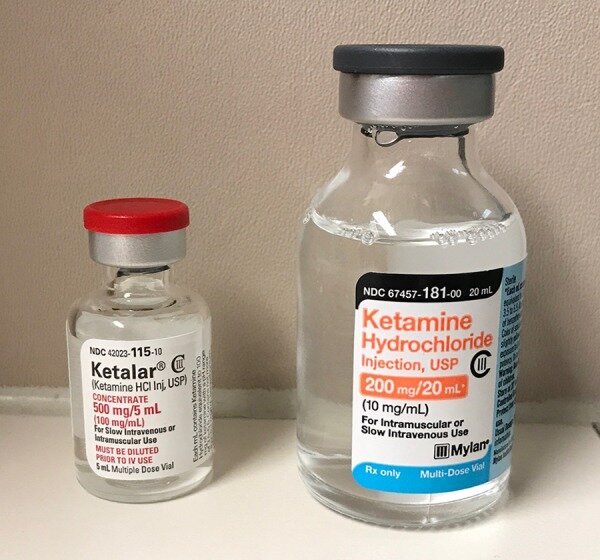
What is Ketamine?
Ketamine is a dissociative anesthetic that has some hallucinogenic effects. Ketamine distorts the perception of sight and sound and makes the user feel disconnected and not in control. It is referred to as a “dissociative anesthetic hallucinogen” because it makes patients feel detached from their pain and environment.
Ketamine can induce a state of sedation (feeling calm and relaxed), immobility, relief from pain, and amnesia (no memory of events while under the influence of the drug) and is abused for the dissociative sensations and hallucinogenic effects. Ketamine has also been used to facilitate sexual assault.
Ketamine is an approved medical product as an injectable, short-acting anesthetic for use in humans and animals and as esketamine (Spravato®; the active form of the drug) as a nasal spray for treatment resistant depression.
Street Title
Cat Tranquilizer, Cat Valium, Jet K, Kit Kat, Purple, Special K, Special La Coke , Super Acid, Super K, Vitamin K
Uses and Side Effects of Ketamine
It’s been more than 60 years since ketamine was discovered, and since then, it’s come to be widely used for general anesthesia. In recent years, it’s also drawn significant interest as a treatment for depression.
At the same time, ketamine can have potentially serious side effects. Its risks are amplified when it is misused, taken as a recreational drug, or administered without cautious monitoring.
Given the potency of ketamine, it’s important for both providers and patients to be informed about its benefits and risks and how to maximize its safety and effectiveness.
Ketamine is a drug that can cause you to see and hear things that aren’t there. It can make you feel disconnected from reality and not in control. It’s used as a short-acting anesthetic for both people and animals. It’s called a “dissociative anesthetic” because it makes you feel separated from your pain and surroundings.
Medical Uses of Ketamine
Ketamine has been used in multiple ways in the practice of medicine. Ketamine and esketamine have only limited approved uses, but they are sometimes prescribed off-label for different health conditions.
Ketamine in Anesthesia
Ketamine was first approved by the FDA in 1970 as an intravenous or intramuscular anesthetic, and it continues to be used for surgery and medical procedures. In this context, ketamine is usually given to patients via an IV, and it can be used alone or with other anesthetics.
Benefits of ketamine as an anesthetic include its pain-relieving effect and the fact that it does not reduce heart rate or blood pressure. However, a downside is its potential to cause hallucinations or other changes in perception and feeling.
Ketamine and Esketamine as Treatments for Depression
Ketamine’s potential as a therapy for depression was first reported in 2000. This kicked off significant interest in its antidepressant effects, especially for the roughly 3 million people in the U.S. with treatment-resistant depression.
For depression, a healthcare provider can prescribe ketamine itself or esketamine, which is one of ketamine’s component molecules.
- Ketamine has not been approved as a treatment for depression, but it may be prescribed as an off-label therapy.
- Esketamine — formulated as a nasal spray known by the product name Spravato — was approved by the FDA in 2019 as a medication for treatment-resistant depression.
One of the things that makes these drugs compelling is that they take effect within hours, which stands in stark contrast to many oral antidepressants that take weeks to affect mood.
The mechanism behind ketamine and esketamine’s effects on depression is not fully understood, but results from various studies suggest that it acts on multiple different receptors in the brain involved in regulating feelings and mental states.
In our practice, we believe in both the psychological and biological benefits of ketamine. Ketamine lifts mood and also raises levels of BDNF — brain-derived neurotrophic factor — which is like “miracle-grow,” for neurons. BDNF increases neuroplasticity, the brain’s ability to change or to see things from a new perspective. Neuroplasticity can be helpful to almost everyone but is especially beneficial for people stuck in low moods or ineffective modes of thinking.
Building on this, we emphasize and incorporate therapy around each ketamine experience, setting intention prior, and debriefing or integration afterward. Put another way, if you think of your brain as chocolate — ketamine softens the chocolate, and therapy around it is the new form that it can “melt” into.
Of course, your brain won’t melt! Ketamine may actually be protective of brain cells. However, it might make it easier to see things in a new way, which can be a huge boost to people with depression. We believe this is a significant advantage to in-office ketamine sessions with mental health experts (versus at home treatment) – the supportive environment and close guidance has been tremendously helpful to our patients.

Reviews
There are no reviews yet.